

Kanna - Explorer Series
Kanna - Explorer Series
Couldn't load pickup availability
Shipping, Pickups & Returns
Shipping, Pickups & Returns
Coffee is shipped on Thursdays.
Shipping is $7 flate rate for the USA.
Free shipping on orders over $70.
Please allow 1-2 days for West Coast, 2-4 days for Midwest and 3-5 days for the East coast. USPS recommends allowing extra time for shipping during the holidays.
We have a pickup location in downtown Hillsboro at Willow & Ash.You can pick up your coffee on Fridays from 11am to 5pm. You can select this option at checkout. Orders placed by end of day Wednesday are delivered early Friday, for pickup on Friday or any day thereafter. We will email you when your order is ready for pickup.
We also have a pickup location in downtown Forest Grove at Guidetti's Marketplace. You can pick up your coffee on Fridays(or after Fridays) from 10am to 7pm. You can select this option at checkout. Orders placed by end of day Wednesday are delivered on Thursday, for pickup on Friday or any day thereafter. We will email you when your order is ready for pickup.
We do not stock grinders, we special order them. Please allow 1-3 days for processing. Our grinders ship UPS Ground, allow 1-5 busniess days for shipping. All Baratza grinders come with a 1 year limited warranty.
The 15% discount for signing up for our newsletter does not apply to grinders.
We do not accept returns on our coffee beans. If your coffee was damaged during shipping or if you are unhappy with your coffee please contact us at vik@vikroasters.com so we can make it right.
Kanna (Can-nuh)
Papua New Guinea - Chimbu Natural Anaerobic
When we tried this coffee we enjoyed the blackberry sweetness and it's syrupy mouthfeel. It's really balanced and pleasant.
Ideal for pour over, drip, french press and cold brew.
Whole Bean
Roast level: Medium
Region: Chuave, Chimbu
Altitude: 1600-1800
Process: Natural Anaerobic
Variety: Arusha, Blue Mountain, Bourbon, Typica
Farm/Producer: Korgua Estate
Anaerobic natural process coffee is made by fermenting whole coffee cherries in sealed, oxygen-free tanks for 48 to 72 hours+, before drying them under the sun. This controlled environment—often achieved with stainless steel tanks—encourages deep, expressive flavor development. The result is a cup that’s bold and layered, with wine-like character, vibrant notes of tropical fruit and berries, pronounced sweetness, and a rich, syrupy body.
Named for its founder, Paul Sirigine—a smallholder farmer with more than two decades of experience—Sirigine Coffee Producers has spent the past five years sourcing award-winning coffees from growers across Chimbu Province.
Chuave is a remote, rugged district nestled between Papua New Guinea’s western and eastern highlands, where coffee is cultivated on steep mountainsides at elevations above 1,600 meters. Harvesting here is demanding work, but the results are exceptional.
This particular lot comes from around 40 smallholder farmers, who cultivate Arusha, Blue Mountain, Bourbon, and Typica varieties in small garden plots.
While Papua New Guinea has historically produced over one million bags of coffee annually, output has dipped below that mark over the past decade. Around 95% of the country’s coffee is grown in the central highland regions, where elevation and climate shape its distinctive character.
Coffees from this region are known for their heavy body and a balance of savory and sweet flavors.
...........................................................................................
Rwanda - Gitwe -Anaerobic Natural
This coffee is fruit forward and juicy, with soft floral notes. It’s refreshing, and that will make it an excellent cold brew coffee this summer.
Ideal for pour over, drip, french press and cold brew.
Whole Bean
Roast level: Medium
Region: Nyamasheke
Altitude: 1800
Process: Natural Anaerobic
Variety: Red Bourbon
Farm/Producer: RTC - Gitwe Washing Station
Anaerobic natural process coffee is made by fermenting whole coffee cherries in sealed, oxygen-free tanks for 48 to 72 hours+, before drying them under the sun. This controlled environment—often achieved with stainless steel tanks—encourages deep, expressive flavor development. The result is a cup that’s bold and layered, with wine-like character, vibrant notes of tropical fruit and berries, pronounced sweetness, and a rich, syrupy body.
Gitwe washing station was built in 2018, laying in the middle of hills covered with green coffee trees. The quality of the coffee known in this area is attributed to the high altitude, the good rain due to the proximity with Nyungwe natural forest, and the volcanic soil off the shores of Lake Kivu. When RTC purchased the station at the beginning of 2019, the plan was to process best fully washed coffee and also try new things. RTC is also heavily involved with farmers at Gitwe, distributing over 60K coffee and shade tree seedlings to help farmers rejuvenate their farms and deal with climate change.
Coffee in Rwanda has always been rooted in smallholder farms, with production growing gradually over time. After independence, the government invested in modernizing infrastructure and centralizing processing. While this improved efficiency, it also meant farmers were locked into fixed prices with little opportunity to differentiate their coffee. With no incentive to focus on quality, even high-potential varieties like Bourbon coffee variety were processed and sold as undifferentiated, commercial-grade lots.
In the early 1990s, Rwanda’s coffee industry showed promise, exporting over 600,000 bags in 1993. But the devastation of the Rwandan genocide led to a dramatic collapse—exports fell to just 22,000 bags in 1995, reflecting the profound human and economic toll.
In the decades since, Rwanda has steadily rebuilt its coffee sector with a renewed focus on quality over volume. Though total export numbers remain lower than pre-1994 levels, the value of Rwandan coffee has grown significantly. Investments from the government and international organizations have supported better processing, quality control, and farmer access to specialty markets—helping position Rwanda as one of the most respected coffee origins in the world today.
Rwanda’s exceptional growing conditions are now matched by equally impressive processing. Over the past two decades, new washing stations have been established across every coffee-growing region, alongside innovative cupping labs and a strong network of cooperatives supporting smallholder farmers.
Most producers cultivate high-quality Bourbon coffee variety, a variety especially well-suited to Rwanda’s high elevations and nutrient-rich volcanic soils. The result is a consistently refined and expressive cup.
Rwandan specialty coffees rank among the finest in the world—valued for their clarity, sweetness, and vibrant character.
...........................................................................................
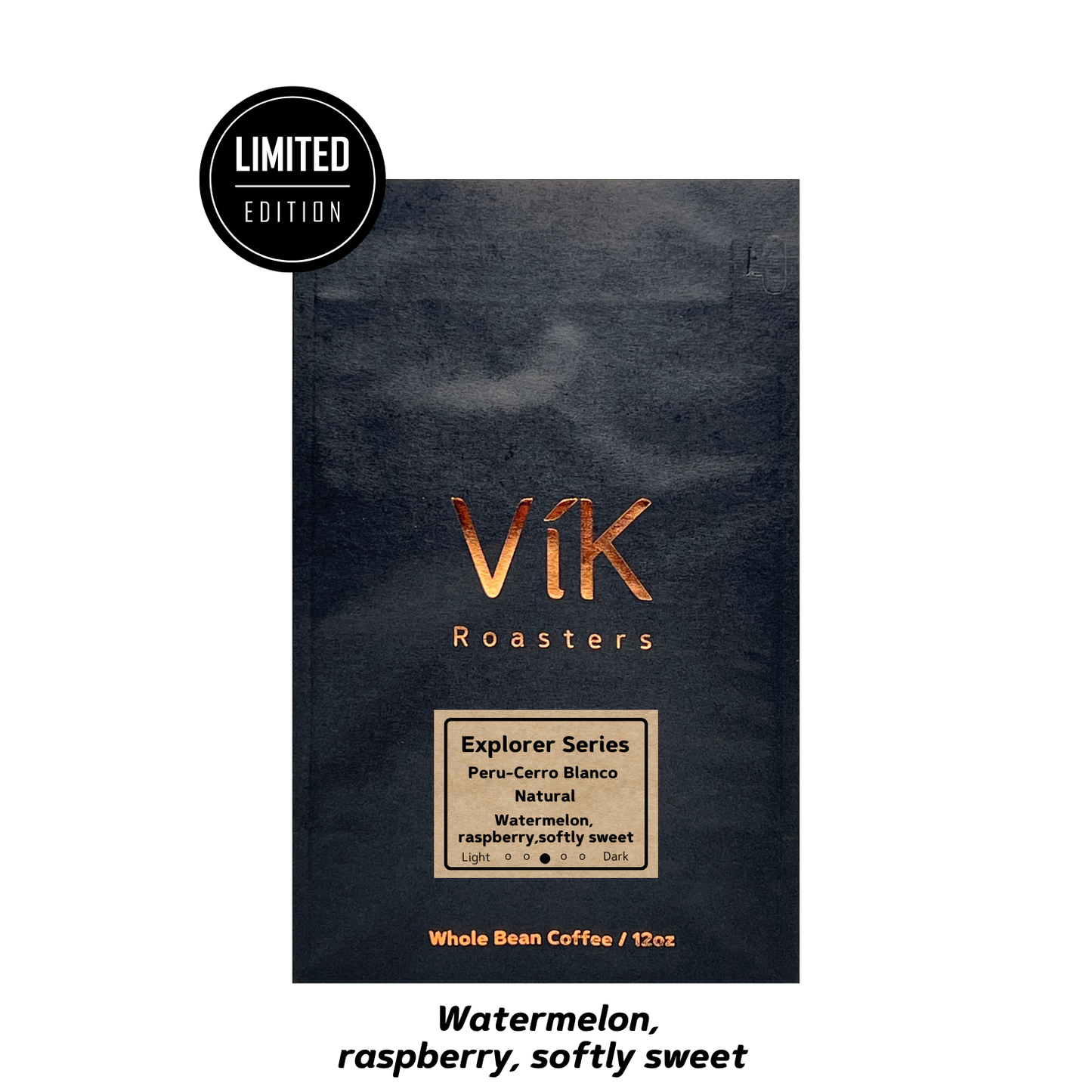
Peru - Cerro Blanco - Natural
This is a summer coffee; fruity, juicy and delicious.
Watermelon, raspberry, softly sweet.
Ideal for pour over, drip, French press, cold brew and iced.
Whole Bean
Roast level: Medium
Region/Area: San Martín
Altitude: 1500 - 1900m
Process: Natural
Variety: Caturra, bourbon, catimor, typica
Farm/Producer: Cerro Blanco Producers Association
In the community of La Victoria, within the San Martín region of Peru, coffee farming has been a cherished tradition passed down through generations. In 2020, local families came together to form the Cerro Blanco Producers Association (APROCEB), named after the iconic white sand mountain that surrounds them.
Peru is made up of a wide variety of landscapes, from long beaches to high mountains, from the desert to the largest rain forest. In the north, the second highest mountain rage, the Andes, goes through Cajamarca department and converges with the Amazon, creating complex and diverse orographies and microclimates. Cajamarca’s inter-Andean valleys have hosted coffee crops for more than 200 years and concentrate almost 43% of the total Peruvian coffee production, not only because of its vast lands but because of an ancient coffee tradition that goes back to the XVIII century, when the first coffee crops were brought in and started to be nurtured by the many generations of producers in the region. Coffee has been part of their lives for so long that their inhabitants’ experiences and learnings are inextricably linked to it.
...........................................................................................
Peru - Eli Chilcon - Extended Fermentation
We like the fruity notes of this coffee and how clean it is. It has a very nice and mild sweetness. An excellent pour over coffee.
Strawberry, honey, stone fruit.
Ideal for pour over, drip and French press. We also think it makes a great cold brew!
Whole Bean
Roast level: Medium light
Region/Area: Cajamarca, San Jose De Lourdes
Altitude: 1800m
Process: Extended Fermentation
Variety: Caturra
Farm/Producer: Eli Chilcon Flores
This lot comes from the La Montaña farm, a 4-hectare plot run by producer Eli Chilcon and his family. The farm is situated at 1800 metres above sea level and is planted exclusively with Caturra. Climate change and fluctuating temperatures are increasingly causing problems for plots at this altitude. Droughts have become more frequent, so one of the key ways to mitigate risks from climate impacts has been the installation of shade trees around the growing areas, as well as effective irrigation systems and fertilizer dispersal to maintain soil health. Following the harvest months of July to October, the picked cherries are rested before being pulped and rested again for 48 hours. They are then washed and dried for a period of around 14 days before being prepared for storage.
The extended fermentation process is a subset of the washed coffees, where the beans are left to ferment longer than the normal day or so. This process requires closer monitoring because it can ruin the coffee if not managed properly. Once it's fermented, it is washed and dried.
This kind of fermentation offers producers a way to produce distinctive flavours and elevate their cup scores, achieving higher prices for their coffees, without requiring a big investment. The process brings out deeper, more complex flavours.
...........................................................................................
Nicaragua - La Bastilla - Natural
For the third year in a row we have this wonderful coffee from La Bastilla Coffee Estates. Pleasant and fruity, it shines in pour over coffee makers like the V60 and Chemex, but is also perfect for drip or the French press. We might also be tempted to try it in our cold brew maker.
Ripe strawberry, raspberry, refreshing.
Ideal for pour over, drip and French press.
Whole Bean
Roast level: Medium / Light
Region/Area: Jinotega
Altitude: 1300 - 1500m
Process: Natural
Variety: Caturra, catuai
Farm/Producer: La Bastille Coffee Estates
La Bastilla's staff diligently selects only the ripest coffee cherries for Natural (dry) processing. This requires planning since drying naturals is a slow process. Coffee cherries are dried whole, without removing any of the fruit. During this stage, the coffee is turned regularly to increase airflow, support even drying, and prevent spoilage.
After the cherries have been dried, the seeds (or coffee beans) are removed from the fruit and prepared for export. The team at La Bastilla strives for strong berry notes and uses a proprietary process that is a "trade secret" of the La Bastilla mill.
La Bastilla Coffee Estates, located in the north-east region of Jinotega, NIcaragua, is renowned for its coffee. Surrounded by the natural reserve Cerro Datanli El Diablo, just a few kilometers from Lago de Apanas, Finca La Bastilla is a tropical paradise for the fauna and flora founded on deep, favorable volcanic soils. Since 2003, the farm has been certified by the Rainforest Alliance and is striving for continued excellence. On its two farms, Finca La Bastilla and Finca Santa Luz, the estate employs around 50 permanent and up to 600 temporary employees during the harvest season.
Micro-farms have been created throughout the estate, so that each coffee can express its full potential in accordance with the different microclimates. Each farm is further divided into lots. Lots are differentiated at the micro-farm level, but also by the variety of the coffee and the altitude.
Additionally, La Bastilla owns its own micro-mill. Every coffee is wet-milled and dry-milled with care. Between coffee varieties and its ability to control processing, La Bastilla is capable of producing more than 150 micro-lot coffees, including bespoke offerings upon request.
Nicaraguan coffee has deep roots in the country’s history and economy. Despite decades of political and environmental challenges, Nicaragua remains one of the world’s top Arabica producers. Coffee farming supports over 330,000 people, with key growing regions including Jinotega, Matagalpa, and Nueva Segovia.
Today, both large estates and smallholders contribute to Nicaragua’s diverse coffee landscape. Estates like La Bastilla showcase the country's potential with micro-lot precision, sustainable processing, and innovative fermentation methods.